

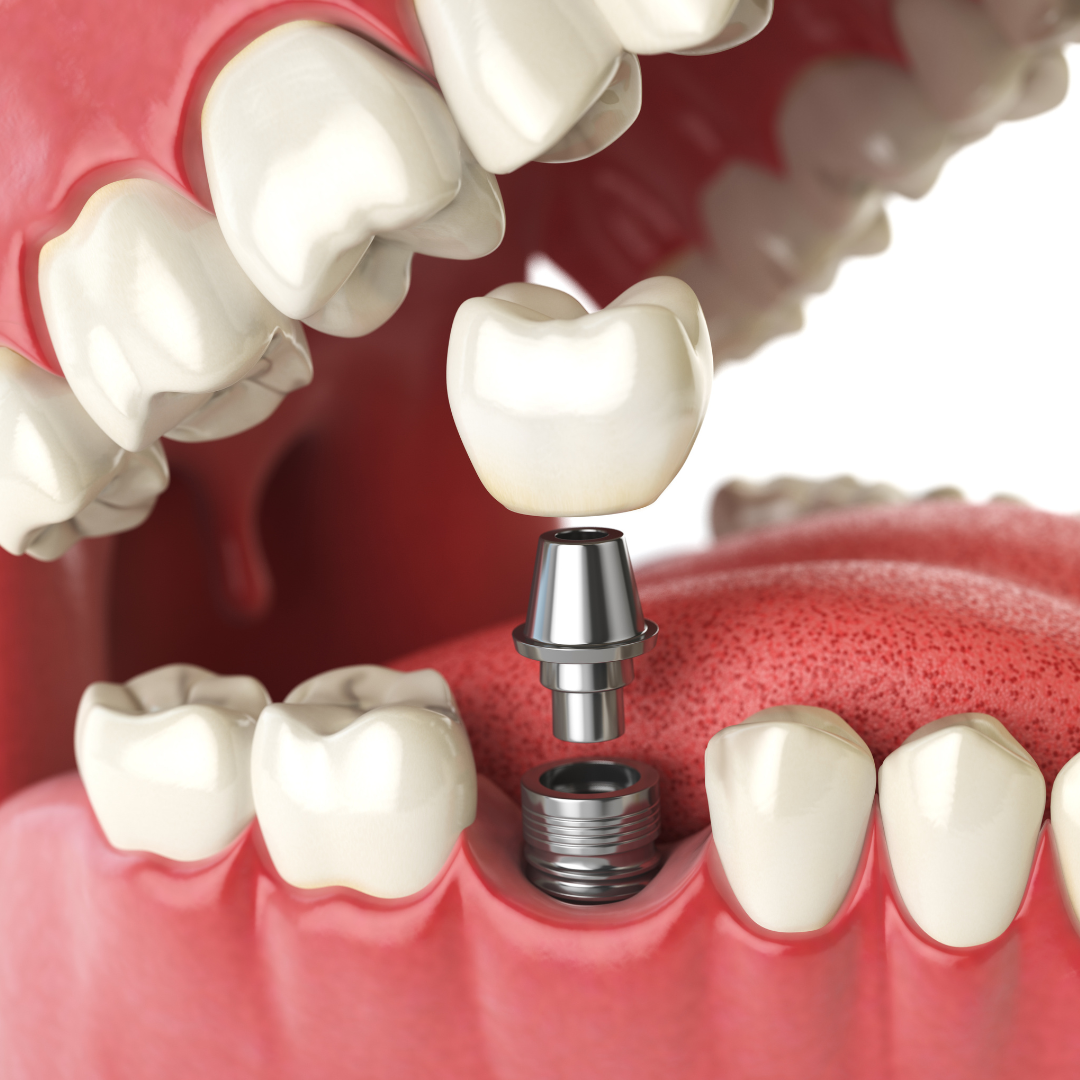
The extensive experience and expertise with dental implants by Dr. Brian Mitchell and Associates are why you can trust your implant surgery to be successful. Dr. Mitchell understands the importance of soft tissue and connective tissue with implant placement. He uses the most up-to-date procedures and a commitment to excellence that assures your comfort and superior results.
Soft Tissue Management
According to the National Library of Medicine, “Soft tissue management plays a crucial role in ensuring long-term implant stability, preventing complications, and enhancing esthetic outcomes.”1
“Achieving aesthetic excellence in dental implant restorations involves more than just placing implants in the right position and choosing the right materials.” according to the American Dental Institute, “It requires a comprehensive understanding of the surrounding soft tissues, as the appearance of the gums around an implant is critical to the overall success of the restoration. Aesthetic implant outcomes are largely determined by how well the soft tissues are managed before, during, and after implant placement.”2
“The success of dental implant therapy relies on achieving optimal osseointegration (the permanent, structural and functional bonding of living bone tissue to an artificial, biocompatible implant) while maintaining the esthetics and function of the surrounding soft tissues.”3

Dr. Mitchell and Associates' High-tech Method
Dr. Brian Mitchell and Associates uses a high-tech 3D X-ray technology that ensures the precise placement of implants for excellent results. This advanced system surpasses traditional “free-hand” methods, delivering outcomes that are not only precise but also provides beautiful results.
How Does It Work?
A “conebeam” X-ray machine captures three-dimensional images of your mouth. With state-of-the-art software, Dr. Brian Mitchell & Associates places your implants virtually, so you cans see the cosmetic results in advance. Next, 3D prints are made to be used as a surgical guide. This guide serves as a blueprint for precise implant placement.
Why Soft Tissue Matters
The Biological Seal: Unlike natural teeth, implants lack connective tissue fibers that anchor directly into the root. Instead, the soft tissue creates a specialized barrier called the permucosal seal. This seal protects the vulnerable titanium threads and prevents bacterial buildup that can lead to peri-implantitis (an infection causing bone loss).
Aesthetics: The thickness and color of the gum tissue determine how natural the final crown looks. Thick, healthy soft tissue hides the metallic or dark components of the implant from showing through.4
Key Characteristics The quality of soft tissue is measured by three main components:
Mucosal Thickness: The thickness of the gums. Thick tissue is desired because it resists recession and minimizes the chance of the implant’s metal showing through.
Keratinized Mucosa Width: The band of tough, firm tissue around the base of the implant. It makes daily cleaning easier and prevents irritation.
Supracrestal Tissue Height: The vertical height of the tissue resting above the bone, which ensures the biological seal remains intact.5
Common Soft Tissue Procedures
If there is insufficient gum tissue at the implant site, a dentist or periodontist may recommend:6
Soft Tissue Grafting: Surgically taking donor tissue (usually from the roof of the mouth) and attaching it to the implant area to increase thickness or keratinized tissue.
Soft Tissue Manipulation: Using customized temporary crowns (provisional restorations) during the healing phase to “sculpt” the gums into a natural, tooth-like shape before the final crown is placed.7

Dr. Brian Mitchell Shares
“My Dental Implant System has transformed the implant process into a nearly painless experience,” said Dr. Brian Mitchell. “
Patients often express surprise at the speed and ease with which implants are placed using this groundbreaking technology.
The Best Choice is Dr. Brian Mitchell and Associates If you are considering dental implants choose Dr. Brian Mitchell and Associates. The extensive experience and expertise with dental implants and tissue augmentation by Dr. Brian Mitchell and Associates is why you will receive the best dental implant. Dr. Brian Mitchell & Associates—where innovation meets compassionate care. Call (520) 523-4860. Located at 6383 E Grant Rd. Suite 155, Tucson, AZ 85715
Terms and Definitions: Connective tissue: the foundational supporting and binding tissues—such as the gums (gingiva), dental pulp, and periodontal ligament—that anchor, nourish, and protect the teeth.
Connective tissue graft: a periodontal surgical procedure that treats gum recession by transplanting soft tissue from beneath the roof of the mouth (palate) to the exposed tooth root.9
Free gingival graft: a periodontal surgical procedure used to treat receding or thin gums. 13
Implant design: in implant surgery this refers to the macroscopic and microscopic structural characteristics of an artificial tooth root. It dictates how the implant integrates with the jawbone (osseointegration) and handles chewing. 14
Implant dentistry: the specialized branch of dentistry focused on replacing missing teeth by surgically anchoring artificial tooth roots into the jawbone.12
Keratinized tissue: (or keratinized mucosa) is the firm, protective band of gum tissue that covers the teeth and dental implants. Keratinized mucosa is rich in keratin. Keratin is a
tough, fibrous protein which makes the keratinized tissue highly resistant to the daily mechanical stress of chewing and brushing.8
Peri-implant soft tissue: (peri-implant mucosa) the seal of gum tissue surrounding a dental implant. 11
Soft tissue: the non-hardened, flexible structures in and around the oral cavity.
Soft tissue augmentation: surgical procedures used to restore volume, contour, and structural health to the gums (implant soft tissue) or jawbone (hard tissue).10
Tissue graft: a surgical procedure where healthy tissue is transplanted to areas where the gums have receded or are too thin is known as a tissue graft or tissue grafting.
Source Material:
1 https://pmc.ncbi.nlm.nih.gov/articles/PMC11946930/
2 – https://americandentalinstitute.com/the-role-of-soft-tissue-management-in-aesthetic-implant-success/
3 – https://pmc.ncbi.nlm.nih.gov/articles/PMC11946930/
4 – https://pmc.ncbi.nlm.nih.gov/articles/PMC3416938/
5 – https://pmc.ncbi.nlm.nih.gov/articles/PMC10477659/
6 – https://pmc.ncbi.nlm.nih.gov/articles/PMC11946930/
7 – https://myoms.org/what-we-do/oral-soft-tissue-surgery/soft-tissue-grafts/
8 – https://www.colgate.com/en-us/oral-health/mouth-and-teeth-anatomy/the-role-of-keratinized-tissue-in-dental-implants
9 – https://hellopearl.com/glossary/connective-tissue-graft
10 – https://pmc.ncbi.nlm.nih.gov/articles/PMC11946930/
11 – https://aap.onlinelibrary.wiley.com/doi/10.1002/JPER.16-0424
12 – https://www.fda.gov/medical-devices/dental-devices/dental-implants-what-you-should-know
13 – https://www.sidneydental.ca/blog/connective-tissue-graft-vs-free-gingival-graft-choosing-the-right-option/